Integrated Smart Gas Operation Management Platform

Gas utilities run long, complex operations spanning safety compliance, engineering and construction, equipment maintenance, and station operations. The norm has been to manage each of these in separate, disconnected systems — data siloed, workflows broken, risk impossible to see in one place. This solution is a one-stop enterprise resource integration platform that brings five core business systems together into a single digital ecosystem covering the full gas operations chain.

It breaks down data silos, unifies resource scheduling, connects workflows end-to-end, and delivers intelligent risk early warning — helping gas enterprises cut costs, tighten safety control, and build an efficient, collaborative, sustainable modern management system.

Solution Overview

A single unified platform serves as the foundation, integrating five subsystems to cover the full gas operations chain — from safety compliance and engineering construction to equipment maintenance, station operations, and regulator repair:

  • Work Safety Standardization Information System — safety compliance, dual-system risk management, work permits, emergency, and training
  • Full-Lifecycle Project Management Platform — from project initiation to settlement; materials, quality, and finance in one
  • Construction Site Visualization System — remote site visibility, schedule, and personnel control
  • LNG Safety Production & Operation Management System — LNG station safety monitoring and operations control
  • Regulator Inspection & Maintenance Platform — regulator equipment ledger, inspection and repair, testing, and spare parts

The approach: a unified data backbone connects every business system, eliminating cross-departmental silos and duplicate data entry. Business workflows close-loop inside the platform, and management rules land consistently from the top down — giving gas operators one integrated control tool from headquarters to the field.

The platform supports phased rollout and on-demand expansion, and it can integrate on top of existing business systems without a rip-and-replace.

The Five Integrated Systems

1. Work Safety Standardization Information System

Built around work safety standardization compliance and the dual-system approach — risk-tiered control plus hidden-hazard identification and remediation — this system digitizes every ledger, workflow, and record in safety management.

  • Dual-system operation — risk point tiered registration; inspection plans with closed-loop remediation; full traceability from inspection to fix to re-inspection
  • Work permit management — online application, approval routing, and on-site sign-off for high-risk work: hot work, confined space, working at heights, lifting
  • Incidents and near-misses — reporting, investigation, handling, and archiving into a reusable incident case library
  • Emergency and training — emergency plans, drill records, safety training ledgers, and competency assessments

2. Full-Lifecycle Project Management Platform

Covers engineering projects end to end — initiation, design, construction, acceptance, and settlement — and pulls materials, quality, and finance into one platform.

  • Materials management — procurement plans, contracts, delivery acceptance, inventory ledgers
  • Engineering quality — construction quality inspections, concealed-work acceptance, closed-loop correction of quality issues
  • Financial control — project budgets, contract payments, cost accounting and settlement
  • Full lifecycle — initiation → design → construction → acceptance → settlement in one chain; schedule, cost, and quality in a single view

3. Construction Site Visualization System

Brings the construction site online so field conditions are visible remotely, supporting site safety and schedule control.

  • Site visibility — on-site video surveillance fed in for remote, real-time viewing of site conditions
  • Schedule visualization — construction progress reported and visualized online, with alerts when a milestone falls behind
  • Personnel and vehicles — entry/exit registration and positioning for workers and vehicles
  • Site safety — alerts for violations: unsafe acts, missing PPE, unauthorized zone entry

4. LNG Safety Production & Operation Management System

Built for the safety and operating profile of LNG storage tanks, vaporization stations, and similar facilities — purpose-built monitoring and control.

  • Operation monitoring — real-time capture of tank level, pressure, temperature, and vaporizer operating parameters
  • Safety alarming — tiered alarms for leak concentration, over-pressure, over-level, and other anomalies, with linked on-site response
  • Loading and unloading — tanker truck transfer operations, online workflow, key-node confirmation
  • Operations ledgers — station operating records, equipment start/stop logs, and inspection records kept online

5. Regulator Inspection & Maintenance Platform

Regulators are core network equipment. This platform professionalizes the management of regulator ledgers, inspections, repairs, testing, and spare parts.

  • Equipment ledger — one record per regulator: model, parameters, installation location, service history
  • Inspection and work orders — inspection plans auto-generated, anomalies triggering closed-loop repair work orders
  • Repair and testing — repair records, test data, periodic-test reminders, full historical traceability
  • Spare parts management — spare-part inventory, draw-out, and low-stock alerts to keep repairs timely

Platform Core Capabilities

Connected Data: One Unified Data Backbone

All five subsystems feed into a single data backbone, eliminating cross-departmental silos and duplicate entry. Safety, engineering, equipment, station, and maintenance data interoperate inside one platform — and management sees the full operation in one view.

Unified Resource Scheduling: Cross-System Coordination

People, materials, vehicles, and funds are scheduled on one platform. Material demand from projects, crew allocation for construction, and staffing for repair work orders coordinate across business lines instead of each running its own.

Seamless Workflow Handoff: No Dropped Threads

Business processes close-loop inside the platform — from work permit applications and construction progress reporting to repair work order handling and settlement payments. Cross-system handoffs don’t drop or duplicate, cutting manual handoffs and information gaps.

Intelligent Risk Early Warning: Cross-Data Alarms

Risk is identified by cross-system data linkage: schedule slippage triggers project alerts, equipment faults trigger repair work orders, LNG operating anomalies trigger safety alarms. Hazards are caught at the first sign and pushed to the responsible person — shortening response time.

Solution Value

Lower costs, higher efficiency
One unified platform replaces scattered, standalone systems — cutting redundant build and re-entry. Online workflows shorten cross-departmental coordination time, raising operational efficiency and lowering management cost.

Tighter safety control
Risk across safety, construction, LNG operations, and equipment maintenance is brought under unified control. The dual-system and work-permit workflows close the loop; hazards are caught and handled early.

Efficient collaboration
Data silos broken, every business line collaborating on one platform — unified resource scheduling, seamless workflow handoff, no more cross-system friction or information gaps.

Sustainable development
Full-chain data accumulates as a management asset, supporting operational analysis, decision optimization, and continuous improvement — the foundation for digital, fine-grained management.

Conclusion

This solution integrates five business systems to connect safety, engineering, construction, LNG operations, and regulator maintenance end-to-end — upgrading gas operations from fragmented management to one-stop collaborative control. Unified resource scheduling, seamless workflow handoff, and intelligent risk early warning help enterprises cut costs, tighten safety, and build an efficient, collaborative, sustainable modern management system.

Deployment can be planned around your actual operating conditions. For product-fit guidance, [contact us] for detailed deployment advice.
Real-Time Monitoring Solution for Urban Gas Distribution

The urban gas network is a critical city lifeline — running from city gate stations and distribution mains, through pressure regulation facilities at every level, all the way to end users. Monitoring points are many, devices are widely scattered, and operational risks often stay hidden. The traditional model — manual periodic inspection and post-fault response — no longer meets today’s bar for smart gas operations and safe production.

This solution brings together IoT sensing, wireless communication, and big data platform technology into a software-hardware integrated real-time monitoring system for urban gas distribution. It connects the full monitoring chain — city gate stations, distribution pipelines, medium- and low-pressure regulator cabinets/boxes, and downstream end users — onto a single smart management platform. Monitoring points that were once scattered and standalone now give you real-time visibility into network operation, safety and risk under control, and efficient operational management — helping gas companies complete their digital safety upgrade.

Solution Overview

This solution covers the full business chain of urban gas distribution — from gas receiving at city gate stations, through pipeline transport and pressure regulation, to end-user supply. It targets four core scenarios:

  • City gate stations — inlet metering, inlet/outlet pressure monitoring, pressure regulation and distribution, safety warning
  • Distribution pipelines — online monitoring of pressure at key nodes, medium temperature, and network operating status
  • Medium- and low-pressure regulation facilities — full-parameter monitoring of regulator cabinets/boxes, anomaly alarming, equipment status diagnostics
  • Downstream users — gas consumption and safety status monitoring at key commercial and industrial accounts

The approach: deploy the right intelligent transmitters, sensing terminals, and acquisition devices for each set of field conditions, then bring all field data onto one smart management platform. Standardized data and processes give gas operators unified, top-down control rules instead of scattered, station-by-station oversight — enabling fine-grained network O&M.

The solution supports phased rollout and flexible expansion. It can add intelligence to existing gas facilities without replacing the main pressure regulation equipment, which keeps retrofit cost down.

System Architecture

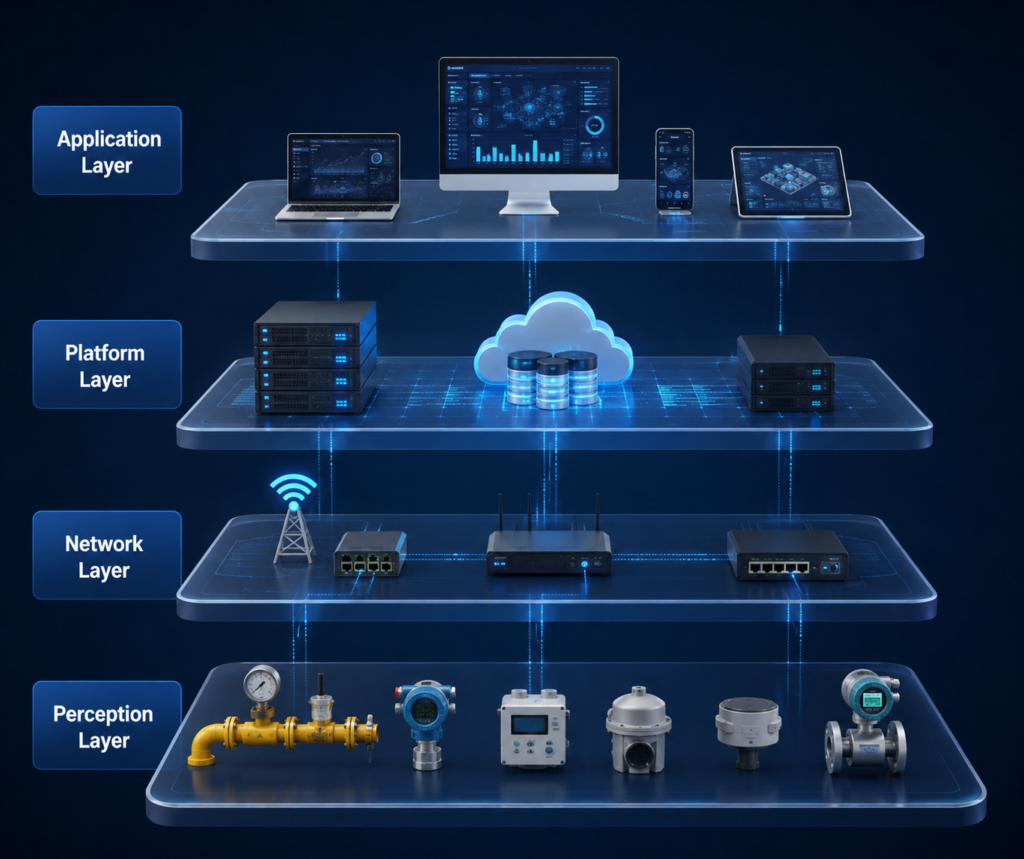
A four-layer distributed architecture that connects the complete data path from field sensing to back-office management:

1. Sensing & acquisition layer (field devices)
Deployed at city gate stations, pipeline nodes, regulator cabinets, and regulator boxes. Pressure transmitters, differential pressure transmitters, temperature transmitters, flow instruments, shut-off valve position sensors, combustible gas leak detectors, and cabinet door status switches capture the raw operating data — pressure, differential pressure, temperature, flow, valve status, gas leak concentration, and door open/close state. An intelligent gas pressure alarm serves as the on-site acquisition host, supporting multi-channel sensor input, performing local data preprocessing and local audible-visual alarming, then uploading everything upstream. Explosion-proof, wide-temperature design suits outdoor cabinet and open-air station conditions.

2. Network transport layer (communication hub)
Communication options include RS485 wired and 4G/Cat-1 or NB-IoT wireless. Pick the best fit for each site’s location and power conditions to keep data backhaul stable across a large number of scattered points; link redundancy is supported to cut signal-drop risk.

3. Platform service layer (alarm and business server)
Receives all uploaded field data and handles real-time data parsing, tiered warning logic, historical storage, and alarm distribution. Built-in alarm models cover over-pressure, under-pressure, differential-pressure exceedance, gas leakage, and abnormal valve action — with customizable alarm thresholds.

4. Application terminal layer (PC + mobile app)
Managers log in via desktop web or mobile to remotely view real-time operating parameters across gate stations, regulator cabinets, and pipeline nodes. When an anomaly triggers on site, the platform pushes a popup and mobile notification to O&M staff without delay.

End-to-end workflow: on-site multi-parameter acquisition → local intelligent terminal preprocessing → secure network transport → server-side data analysis and risk warning → remote monitoring and alarm handling on PC/mobile.

Core Capabilities

Pressure Safety Monitoring

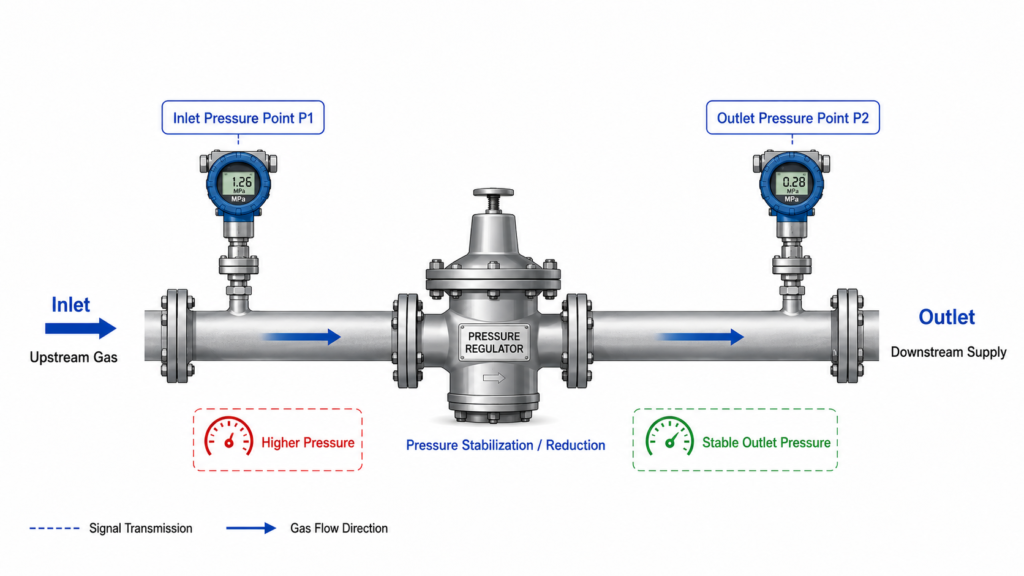
Pressure is the single most critical safety variable in gas distribution. The system continuously acquires regulator inlet pressure, regulated outlet pressure, pressure at key pipeline nodes, and differential pressure across filters. The moment a parameter crosses its preset safety threshold, the platform fires a tiered warning and can link to field actuators such as shut-off valves to quickly prevent over-pressure or loss-of-pressure incidents.

  • Parameters: medium pressure, filter differential pressure
  • Targets: regulators, city gate stations, key pipeline nodes
  • Focus: real-time inlet/outlet pressure monitoring, tiered high/low-pressure anomaly warning, filter-element clogging differential-pressure warning

Pipeline Condition Monitoring

Pipeline equipment is spread across the network, and hidden faults are hard to catch in time. The system continuously captures pipeline medium temperature, instantaneous and cumulative flow, shut-off valve spool action status, and regulator cabinet door open/close state — building a full digital picture of pipeline operation. It flags hidden faults the moment they appear: unexpected shut-off valve closure, abnormal regulator cabinet door opening, abnormal flow fluctuation.

  • Parameters: pipeline medium temperature, instantaneous & cumulative flow, shut-off valve position status, regulator cabinet door switch signal
  • Targets: distribution pipelines, skid-mounted equipment at gate stations, regulator cabinets, regulator boxes
  • Focus: full-picture visibility of pipeline equipment status, instant alarming on abnormal states — closing the blind spots of manual inspection

Intelligent Leak Detection

Gas leakage is the top-priority safety risk. The solution deploys combustible gas concentration detectors inside regulator cabinets, at flange joints, and at pipeline connections — the high-frequency leak zones — to monitor natural gas leak concentration in real time. When concentration reaches the warning threshold, the on-site audible-visual alarm fires and the alarm signal uploads to the management platform, pushing the hazard out instantly. It supports linkage with safety shut-off devices, so leak risk is caught early and handled early.

  • Parameters: methane leak concentration
  • Targets: leak-prone points — inside regulator cabinets, valve flanges, pipeline joints
  • Focus: real-time leak concentration monitoring, on-site audible-visual alarm + platform remote alarm with linked response

Monitored Parameters at a Glance

ParameterWhere it’s monitored
Pressure / differential pressureCity gate stations, regulators, key pipeline nodes, filter differential-pressure monitoring
Combustible gas leak concentrationRegulator cabinets, valve pits, pipeline flange joints and other high-frequency leak points
Pipeline medium temperatureDistribution mains, city gate stations, regulator skids
Instantaneous & cumulative flowGate station metering, main pipelines, key commercial & industrial users
Shut-off valve operating statusCity gate stations, internal safety shut-off valves in regulator cabinets
Regulator cabinet door open/close statusOutdoor floor-standing regulator cabinets
Ball valve on/off statusKey valves at pipeline branches

Transmitters and monitoring parameters can be flexibly selected to match each site’s actual needs — one monitoring platform covers pressure safety, equipment status, and leak protection across all dimensions.

Regulator Station Warning System: The Core Deployment Module

Pressure regulation facilities are the network’s highest-fault-risk equipment, which makes the regulator box/station warning system the core deployment unit of the whole solution.

Built on the intelligent gas regulation monitoring terminal as its hardware base, with transmitters selected as needed, a single warning system acquires pressure, differential pressure, medium temperature, gas leak concentration, flow, shut-off valve position, and cabinet door status at the same time — single-point deployment, multi-dimensional monitoring. The acquisition terminal is explosion-proof, low-power, supports multiple communication modes, and offers local storage plus on-site audible-visual alarm — built for long-term stable operation of outdoor unattended regulator cabinets. All monitoring data uploads to the smart gas platform for remote, digital O&M of regulator stations.

Solution Value

Safety under control — from reactive repair to proactive prevention
24/7 uninterrupted online monitoring fills the time gaps that manual inspection leaves. Pressure anomalies, gas leaks, and equipment faults trigger warnings at the first sign — shortening response time and cutting the risk of network safety incidents.

Operational efficiency — lower on-site O&M cost
One unified platform centrally manages all station equipment. It replaces fragmented, multi-system oversight, cuts redundant cross-platform data entry, optimizes inspection scheduling, and lets O&M staff do more — lowering the cost of field rounds.

Fine-grained management — digital control of the network
All network operating data converges in one place, breaking the pattern of each station running on its own rules. Historical platform data feeds operating-condition analysis and fault-pattern statistics, giving you a data backbone for network retrofitting, equipment maintenance planning, and gas-supply dispatch — true digital fine-grained management.

Software-hardware integrated — easier to deploy
This solution delivers both the main pressure regulation equipment and the intelligent monitoring terminal. Hardware and software are tightly matched, which cuts the integration and commissioning work of dealing with multiple vendors. The overall system is more stable, and later O&M is simpler.

Where It Fits

This solution fits a range of gas business scenarios and supports both greenfield projects and intelligent upgrade retrofits of existing stations:

  • Citywide gas network monitoring — end-to-end real-time online monitoring from city gate stations down to medium- and low-pressure networks
  • Unattended regulator station/cabinet retrofit — remote monitoring of regulator facilities in residential areas, along roads, and in industrial parks
  • Industrial park centralized gas safety — centralized safety control of park regulator skids and pipeline nodes
  • Pipeline inspection & emergency dispatch — remote real-time visibility into network anomalies, supporting emergency response dispatch

Conclusion

This solution integrates hardware sensing, IoT communication, and a smart management platform to connect the full monitoring chain — city gate stations → distribution pipelines → pressure regulation facilities → end users. It covers risk control across three dimensions: pressure safety, equipment status, and gas leakage — helping gas operators build a real-time visible, safety-controllable, data-driven smart distribution control system.

Deployment can be planned to match your network’s actual condition. To learn more about the product fit, [contact us] for detailed deployment guidance.