Real-Time Monitoring Solution for Urban Gas Distribution
The urban gas network is a critical city lifeline — running from city gate stations and distribution mains, through pressure regulation facilities at every level, all the way to end users. Monitoring points are many, devices are widely scattered, and operational risks often stay hidden. The traditional model — manual periodic inspection and post-fault response — no longer meets today’s bar for smart gas operations and safe production.
This solution brings together IoT sensing, wireless communication, and big data platform technology into a software-hardware integrated real-time monitoring system for urban gas distribution. It connects the full monitoring chain — city gate stations, distribution pipelines, medium- and low-pressure regulator cabinets/boxes, and downstream end users — onto a single smart management platform. Monitoring points that were once scattered and standalone now give you real-time visibility into network operation, safety and risk under control, and efficient operational management — helping gas companies complete their digital safety upgrade.
Solution Overview
This solution covers the full business chain of urban gas distribution — from gas receiving at city gate stations, through pipeline transport and pressure regulation, to end-user supply. It targets four core scenarios:
- City gate stations — inlet metering, inlet/outlet pressure monitoring, pressure regulation and distribution, safety warning
- Distribution pipelines — online monitoring of pressure at key nodes, medium temperature, and network operating status
- Medium- and low-pressure regulation facilities — full-parameter monitoring of regulator cabinets/boxes, anomaly alarming, equipment status diagnostics
- Downstream users — gas consumption and safety status monitoring at key commercial and industrial accounts
The approach: deploy the right intelligent transmitters, sensing terminals, and acquisition devices for each set of field conditions, then bring all field data onto one smart management platform. Standardized data and processes give gas operators unified, top-down control rules instead of scattered, station-by-station oversight — enabling fine-grained network O&M.
The solution supports phased rollout and flexible expansion. It can add intelligence to existing gas facilities without replacing the main pressure regulation equipment, which keeps retrofit cost down.
System Architecture
A four-layer distributed architecture that connects the complete data path from field sensing to back-office management:
1. Sensing & acquisition layer (field devices)
Deployed at city gate stations, pipeline nodes, regulator cabinets, and regulator boxes. Pressure transmitters, differential pressure transmitters, temperature transmitters, flow instruments, shut-off valve position sensors, combustible gas leak detectors, and cabinet door status switches capture the raw operating data — pressure, differential pressure, temperature, flow, valve status, gas leak concentration, and door open/close state. An intelligent gas pressure alarm serves as the on-site acquisition host, supporting multi-channel sensor input, performing local data preprocessing and local audible-visual alarming, then uploading everything upstream. Explosion-proof, wide-temperature design suits outdoor cabinet and open-air station conditions.
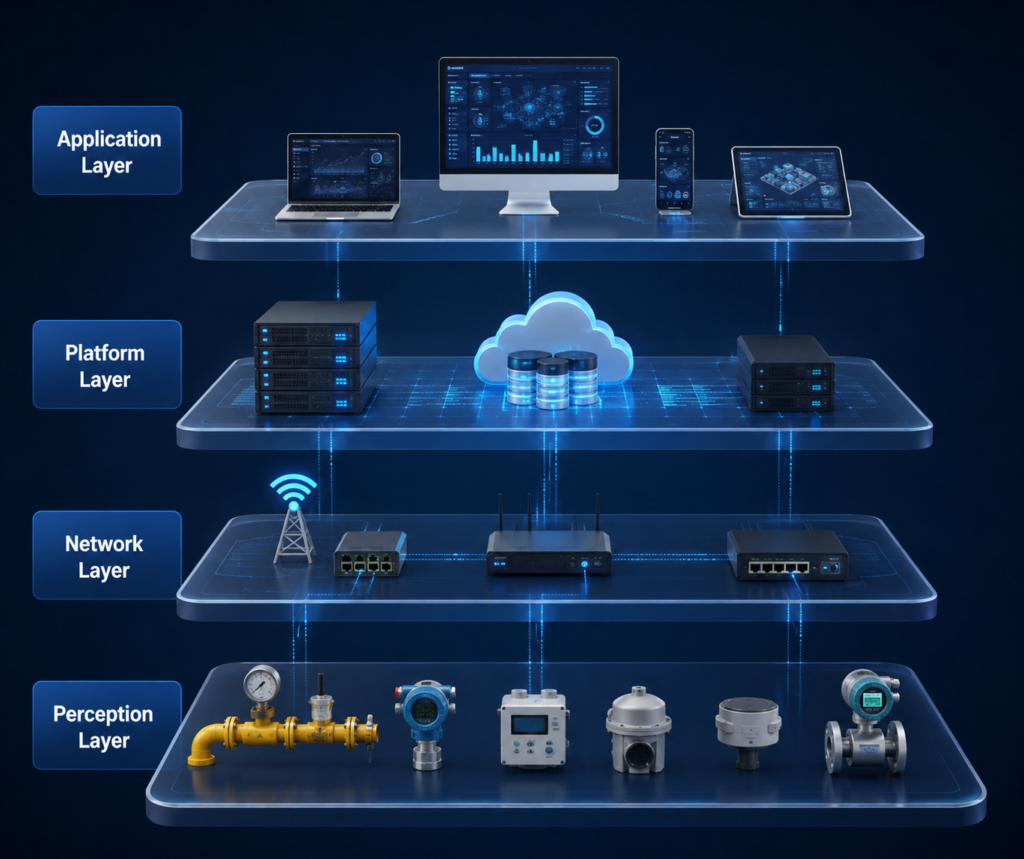
2. Network transport layer (communication hub)
Communication options include RS485 wired and 4G/Cat-1 or NB-IoT wireless. Pick the best fit for each site’s location and power conditions to keep data backhaul stable across a large number of scattered points; link redundancy is supported to cut signal-drop risk.
3. Platform service layer (alarm and business server)
Receives all uploaded field data and handles real-time data parsing, tiered warning logic, historical storage, and alarm distribution. Built-in alarm models cover over-pressure, under-pressure, differential-pressure exceedance, gas leakage, and abnormal valve action — with customizable alarm thresholds.
4. Application terminal layer (PC + mobile app)
Managers log in via desktop web or mobile to remotely view real-time operating parameters across gate stations, regulator cabinets, and pipeline nodes. When an anomaly triggers on site, the platform pushes a popup and mobile notification to O&M staff without delay.
End-to-end workflow: on-site multi-parameter acquisition → local intelligent terminal preprocessing → secure network transport → server-side data analysis and risk warning → remote monitoring and alarm handling on PC/mobile.
Core Capabilities
Pressure Safety Monitoring
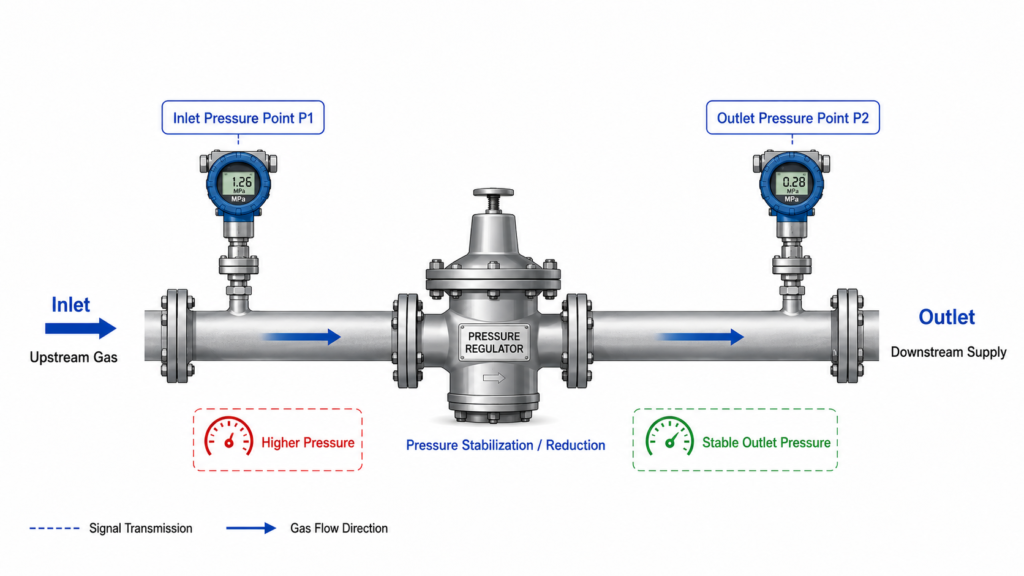
Pressure is the single most critical safety variable in gas distribution. The system continuously acquires regulator inlet pressure, regulated outlet pressure, pressure at key pipeline nodes, and differential pressure across filters. The moment a parameter crosses its preset safety threshold, the platform fires a tiered warning and can link to field actuators such as shut-off valves to quickly prevent over-pressure or loss-of-pressure incidents.
- Parameters: medium pressure, filter differential pressure
- Targets: regulators, city gate stations, key pipeline nodes
- Focus: real-time inlet/outlet pressure monitoring, tiered high/low-pressure anomaly warning, filter-element clogging differential-pressure warning
Pipeline Condition Monitoring
Pipeline equipment is spread across the network, and hidden faults are hard to catch in time. The system continuously captures pipeline medium temperature, instantaneous and cumulative flow, shut-off valve spool action status, and regulator cabinet door open/close state — building a full digital picture of pipeline operation. It flags hidden faults the moment they appear: unexpected shut-off valve closure, abnormal regulator cabinet door opening, abnormal flow fluctuation.
- Parameters: pipeline medium temperature, instantaneous & cumulative flow, shut-off valve position status, regulator cabinet door switch signal
- Targets: distribution pipelines, skid-mounted equipment at gate stations, regulator cabinets, regulator boxes
- Focus: full-picture visibility of pipeline equipment status, instant alarming on abnormal states — closing the blind spots of manual inspection
Intelligent Leak Detection
Gas leakage is the top-priority safety risk. The solution deploys combustible gas concentration detectors inside regulator cabinets, at flange joints, and at pipeline connections — the high-frequency leak zones — to monitor natural gas leak concentration in real time. When concentration reaches the warning threshold, the on-site audible-visual alarm fires and the alarm signal uploads to the management platform, pushing the hazard out instantly. It supports linkage with safety shut-off devices, so leak risk is caught early and handled early.
- Parameters: methane leak concentration
- Targets: leak-prone points — inside regulator cabinets, valve flanges, pipeline joints
- Focus: real-time leak concentration monitoring, on-site audible-visual alarm + platform remote alarm with linked response
Monitored Parameters at a Glance
| Parameter | Where it’s monitored |
|---|---|
| Pressure / differential pressure | City gate stations, regulators, key pipeline nodes, filter differential-pressure monitoring |
| Combustible gas leak concentration | Regulator cabinets, valve pits, pipeline flange joints and other high-frequency leak points |
| Pipeline medium temperature | Distribution mains, city gate stations, regulator skids |
| Instantaneous & cumulative flow | Gate station metering, main pipelines, key commercial & industrial users |
| Shut-off valve operating status | City gate stations, internal safety shut-off valves in regulator cabinets |
| Regulator cabinet door open/close status | Outdoor floor-standing regulator cabinets |
| Ball valve on/off status | Key valves at pipeline branches |
Transmitters and monitoring parameters can be flexibly selected to match each site’s actual needs — one monitoring platform covers pressure safety, equipment status, and leak protection across all dimensions.
Regulator Station Warning System: The Core Deployment Module
Pressure regulation facilities are the network’s highest-fault-risk equipment, which makes the regulator box/station warning system the core deployment unit of the whole solution.
Built on the intelligent gas regulation monitoring terminal as its hardware base, with transmitters selected as needed, a single warning system acquires pressure, differential pressure, medium temperature, gas leak concentration, flow, shut-off valve position, and cabinet door status at the same time — single-point deployment, multi-dimensional monitoring. The acquisition terminal is explosion-proof, low-power, supports multiple communication modes, and offers local storage plus on-site audible-visual alarm — built for long-term stable operation of outdoor unattended regulator cabinets. All monitoring data uploads to the smart gas platform for remote, digital O&M of regulator stations.
Solution Value
Safety under control — from reactive repair to proactive prevention
24/7 uninterrupted online monitoring fills the time gaps that manual inspection leaves. Pressure anomalies, gas leaks, and equipment faults trigger warnings at the first sign — shortening response time and cutting the risk of network safety incidents.
Operational efficiency — lower on-site O&M cost
One unified platform centrally manages all station equipment. It replaces fragmented, multi-system oversight, cuts redundant cross-platform data entry, optimizes inspection scheduling, and lets O&M staff do more — lowering the cost of field rounds.
Fine-grained management — digital control of the network
All network operating data converges in one place, breaking the pattern of each station running on its own rules. Historical platform data feeds operating-condition analysis and fault-pattern statistics, giving you a data backbone for network retrofitting, equipment maintenance planning, and gas-supply dispatch — true digital fine-grained management.
Software-hardware integrated — easier to deploy
This solution delivers both the main pressure regulation equipment and the intelligent monitoring terminal. Hardware and software are tightly matched, which cuts the integration and commissioning work of dealing with multiple vendors. The overall system is more stable, and later O&M is simpler.
Where It Fits
This solution fits a range of gas business scenarios and supports both greenfield projects and intelligent upgrade retrofits of existing stations:
- Citywide gas network monitoring — end-to-end real-time online monitoring from city gate stations down to medium- and low-pressure networks
- Unattended regulator station/cabinet retrofit — remote monitoring of regulator facilities in residential areas, along roads, and in industrial parks
- Industrial park centralized gas safety — centralized safety control of park regulator skids and pipeline nodes
- Pipeline inspection & emergency dispatch — remote real-time visibility into network anomalies, supporting emergency response dispatch
Conclusion
This solution integrates hardware sensing, IoT communication, and a smart management platform to connect the full monitoring chain — city gate stations → distribution pipelines → pressure regulation facilities → end users. It covers risk control across three dimensions: pressure safety, equipment status, and gas leakage — helping gas operators build a real-time visible, safety-controllable, data-driven smart distribution control system.
Deployment can be planned to match your network’s actual condition. To learn more about the product fit, [contact us] for detailed deployment guidance.